What is behavioural finance, and how does it affect investing?
Knowing where and whether to invest can be challenging, specially now we can access news and opinions from around the world. While this information offers more options, it can be overwhelming, leading to poor decision-making and disappointing investment outcomes.
Updated: 12.05.26
- What is behavioural finance?
- Traditional finance vs. behavioural finance – what’s the difference?
- Five common behavioural biases in investing
- Is understanding behavioural finance actually useful?
- How can investors avoid behavioural biases?
- How an independent financial planner keeps you objective
- Objective decision-making from Alan Boswell Group
- FAQs
In this article
- What is behavioural finance?
- Traditional finance vs. behavioural finance – what’s the difference?
- Five common behavioural biases in investing
- Is understanding behavioural finance actually useful?
- How can investors avoid behavioural biases?
- How an independent financial planner keeps you objective
- Objective decision-making from Alan Boswell Group
- FAQs
To help you avoid this, we explore the idea of behavioural finance, how it can influence your choices, and what you can do to prevent it from affecting your own wealth management decisions.
What is behavioural finance?
Behavioural finance is an area of research that explores how psychology and cognitive bias affect financial decision-making. The concept was pioneered by Amos Tversky and Nobel Prize Winner, Daniel Kahneman and is the basis of prospect theory in economics.
Traditional finance vs. behavioural finance – what’s the difference?
Traditional finance (traditional economics) is the idea that assumes people are rational decision makers who make choices with the aim of maximising value. The model also centres around mathematical formulas to predict returns based on risk (the Capital Asset Pricing Model or CAPM).
In contrast, behavioural finance focuses on human behaviour and how psychology, our own biases, and emotions influence financial decisions. Where traditional economics focuses on facts (such as market expectations based on all the relevant information), behavioural finance centres on prospect theory to explain anomalies in financial markets.
Five common behavioural biases in investing
Behavioural bias describes the attitudes and beliefs we hold without really knowing why; fundamentally, it’s about ‘gut feelings’.
Typically, we use these biases as mental shortcuts to make quick decisions, for example, if red is your favourite colour, it might mean you walk through a red door instead of a green one. Often, these behavioural biases result from our own lived experiences and attitudes of friends and family, particularly as we grow up.
In the context of behavioural finance, behavioural bias often explains why poor decisions are made. It’s how your unconscious beliefs shape financial decisions rather than basing them on research, data, and facts.
You may not feel as if your decisions are affected by behavioural bias, but bias is something that most of us simply aren’t aware of.
Typical biases that affect investment decisions include:
Herd mentality
This is when decisions are made based on what everyone else seems to be doing.
Herd mentality can be good if the action is based on facts, but it can also lead to a false sense of security. After all, if the majority of other investors are doing it, shouldn’t you be?
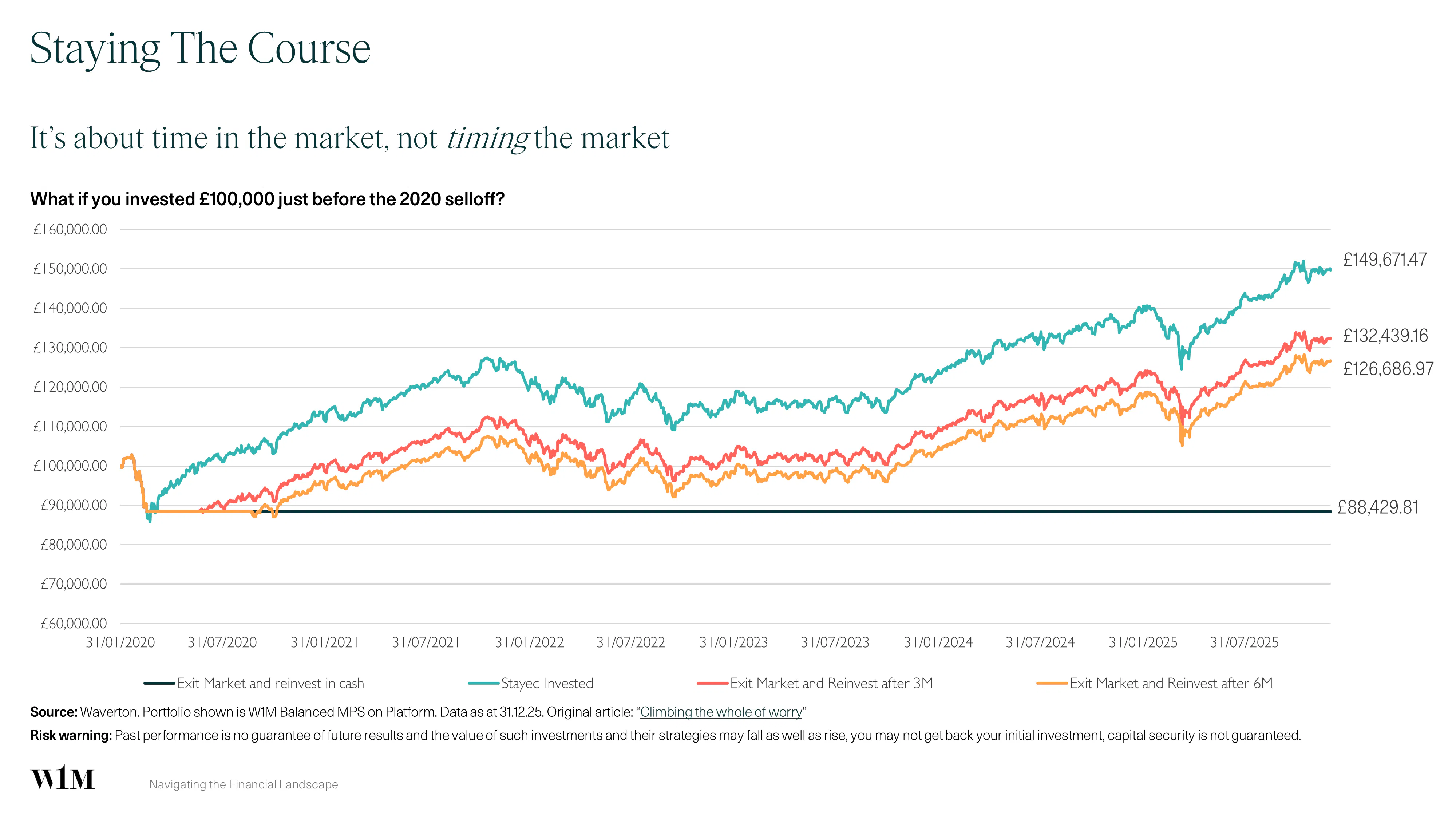
Fear of missing out can lead to hasty decisions that result in poor outcomes. For example, panic selling in an economic downturn or buying overvalued assets.
The example above, provided by W1M, shows the impact of the market downturn in early 2020. It shows the performance of their Balanced MPS until December 2025 and compares it with exiting the market for all or part of that period.
Please note that this is used purely as an example and is not a personal recommendation to invest in a particular portfolio. Where someone invests depends on a number of factors, including the level of risk they are prepared to take and how long they are looking to invest for.
Availability bias
Availability bias is about information retrieval. Specifically, it describes how we tend to remember news more easily when it is recent, and how some stories stick in our minds.
However, the information we recall immediately might be sensationalist or unusual (hence why we remember it). More often than not, availability bias leads to knee-jerk reactions based on rare or unique events.
For example, the news might be filled with stories that cause the price of gold to drop. As the news becomes more widespread (or sensationalist), you may decide to sell any gold assets you have.
In the short term, that decision might seem good, but after the headlines stop, it might prove hasty.
Confirmation bias
This is where we focus, on or actively seek out, information that supports our opinions (albeit unconsciously). Any negative or conflicting information found is ignored, so that the positive stories are amplified.
For example, you might want to invest in a company whose ESG values align with your own. Your enthusiasm could lead you to downplay emerging stories about poor leadership or exaggerated targets. As a result, you could end up buying shares in an overvalued company, potentially leading to significant losses.
Endowment effect
The endowment effect is also known as ownership bias. It’s when we place greater value or importance on the things we already own. For example, if you decide to sell your car, you might base its sale price on that you think it’s a desirable vehicle. In reality, your car may not hold the value you think it does, and it’s only worth what people are willing to pay for it (or what the market dictates).
The endowment effect could mean you hold on to poor-value assets longer than necessary, rather than letting them go at the right time.
Loss aversion
This simply describes our dislike of losing.
Loss aversion works alongside many other behavioural biases. For example, the desire not to lose out on a potentially profitable investment might drive you to make a decision based on herd mentality.
It’s also closely linked to the endowment effect – keeping assets that should be sold, because we don’t want to sell them at a loss.
Is understanding behavioural finance actually useful?
Yes. Behavioural finance highlights how our lived experiences and attitudes influence how we make decisions. Being self-aware and understanding the traps we can fall into can help us shift our mindset and make more rational, fact-based decisions.
Behavioural finance is also used by the UK’s financial regulator, the Financial Conduct Authority (FCA). The FCA is particularly interested in this area so it can find ways of encouraging investors to make more rational, fact-based decisions and mitigate poor outcomes. From a broader perspective, behavioural economics also helps the FCA understand market movements and how anomalous events occur (like financial bubbles).
How can investors avoid behavioural biases?
One of the most practical ways to avoid behavioural biases affecting your investment decisions is to use an independent financial planner who will be able to make rational, fact-based recommendations based on your goals.
However, if you’re planning to manage your own investments, there are several practical steps you can take to avoid behavioural biases, including:
Carefully consider what you read – try to view headlines and stories objectively. If something is portrayed in a certain way, checking its source can help you determine its intention and accuracy.
Be mindful of the herd – don’t rely on others for your information without doing your own research.
Remember your objectives – it’s easy to be swayed by quick wins, but don’t forget what you want to achieve. For example, if potential steady growth is your focus in retirement planning, keeping this in mind can help you avoid rash decisions.
Diversify your portfolio – by saving and investing in several different assets across a range of sectors or industries, you can spread risk and potentially minimise overall losses. Portfolio diversification can also provide surprises that can help challenge any biases you may have.
How an independent financial planner keeps you objective
Behavioural biases affect all of us, but financial planners will be aware of how they can affect decisions and will act objectively and without emotion.
Independent financial planners work with you to establish your financial position and your financial goals, formulating a plan that aims to help you to reach them. With this in mind, a financial planner will base decisions on the market as a whole and will consider research and data, as well as the geopolitical context. Financial planners then use this information (which removes the emotional guesswork) to keep your investments aligned with your own financial goals.
When you choose a financial planner, remember to check the Financial Services Register to confirm they’re authorised to provide financial advice.
FAQs
Yes. Behavioural finance is considered a real science and is a branch of economic study supported by research. It is also used by the Financial Conduct Authority to better understand human decision-making.
This is an example of behavioural finance. The 70/30 rule is that roughly 70% of a portfolio should be dedicated to stocks, and 30% to bonds. The phrase is often attributed to Warren Buffett (one of the best-known investors of all time). However, everyone’s circumstances are different, and where someone invests depends on a number of factors, including the level of risk they are prepared to take and how long they are looking to invest for.
Objective decision-making from Alan Boswell Group
Understanding the importance of objectivity isn’t the same as being objective yourself, and financial decisions can feel overwhelming.
So, if you’re not sure you can avoid bias from affecting your investment decisions, we can help. As independent financial planners, we take a personalised approach to wealth management, ensuring that your investments support your goals and tie in with other financial decisions you face, including retirement planning.
To find out more or to speak to our team, call us on 01603 967967.
The value of investments and any income from them can go down as well as up and you might not get back the original amount invested. The past is not a guide to the future. The value of tax benefits depends on your individual circumstances. Tax laws can change.
Independent investment advice from Alan Boswell Group
Our wealth management service can help you make the most of your existing assets to secure your financial future.
As we’re independent, we’re not restricted to only recommend certain products. It also means we can take a flexible approach and offer solutions aligning with your goals.
Plus, as we believe in a one-to-one service, you’ll be assigned your own personal wealth manager.
To learn more about our financial planning services, including advice on savings and investments, contact our team.
Related guides and insights

How to account for inflation in your retirement planning
When you plan for your retirement, it's important you consider inflation. If you don't, you can't realistically evaluate how much your pension will provide at retirement.

How to choose a financial adviser in the UK
When faced with a major financial decision, a financial adviser can help you make the most of your finances. But, with so many out there, how do you know where to start? Senior Financial Planner, Tony Robinson, explains how to choose a financial adviser that’s right for you.

Pensions for young adults: why starting early is crucial for your retirement savings
If you’re several decades away from retirement, thinking about your pension might be low on your list of priorities – but the sooner you start, the more likely you are to afford the lifestyle you want in retirement.

RPI vs CPI: what’s the difference?
We all feel the effects of rising inflation as it eats away at our income, savings, and purchasing power. But how is inflation calculated, and how do the RPI and CPI indices affect our personal finances?