How to legally increase your tenant's rent
The Renters’ Rights Act now means there are new rules for rent increases in England. For landlords, failing to follow the proper procedure voids the request, and you won’t be able to enforce it. To ensure you don’t get caught out, we look at how to legally increase your tenant’s rent.
Updated: 01.06.26
This content was factually correct when written but may not reflect current developments or information.
- The new rules for rent increases under the Renters' Rights Act
- How much can a landlord increase the rent by?
- How to issue a Section 13 rent increase notice
- What happens if a tenant refuses a rent increase?
- Should you increase rent every year?
- Protecting your income if a rent increase leads to arrears
- FAQs
- Protect your assets with award-winning landlord insurance
In this article
- The new rules for rent increases under the Renters' Rights Act
- How much can a landlord increase the rent by?
- How to issue a Section 13 rent increase notice
- What happens if a tenant refuses a rent increase?
- Should you increase rent every year?
- Protecting your income if a rent increase leads to arrears
- FAQs
- Protect your assets with award-winning landlord insurance
The new rules for rent increases under the Renters' Rights Act
The Renters’ Rights Act has abolished fixed-term tenancies and in-tenancy rent review clauses. It means that all standard rental agreements are now rolling tenancies (Assured Periodic Tenancies, APTs) and rent can only be increased once per year in England (and not within the first year of the tenancy).
If you decide to increase the rent, you must follow the Section 13 process and give your tenants at least two months’ notice.
As housing law is devolved, if your rental property is in Wales, Scotland or Northern Ireland, the rules are slightly different:
Rent increases in Wales
In Wales, there are strict rules around rent rises. Tenants must be given at least two months’ notice of an increase, and only one increase can be given each year. To give notice of a rent rise, you’ll need to complete form RHW12, available at gov.wales.
Rent increases in Scotland
If your rental property is in Scotland, your tenants must be given at least three months’ notice. Rent increases can be requested only once per year. You can create or download a rent increase notice at mygov.scot.
Rent increases in Northern Ireland
Tenants in Northern Ireland must be given at least three months’ written notice of a rent increase; this can be by email, letter, or text. Rent can only be increased once every 12 months. You can find more information at nidirect.gov.
How much can a landlord increase the rent by?
If you’re a private landlord, there’s no specific cap on how much you can increase rent by. In contrast, social landlords in England can only increase rent in line with the CPI (consumer price index), plus 1%; currently, this is 4.8%.
That said, private landlords should only increase the rent in line with the current market rate in your area. In other words, the increase cannot exceed what a new tenant would pay.
There are currently no limits on how much you can increase rent by in Wales, Scotland, or Northern Ireland, but the expectation is that rent should be consistent with open-market rates.
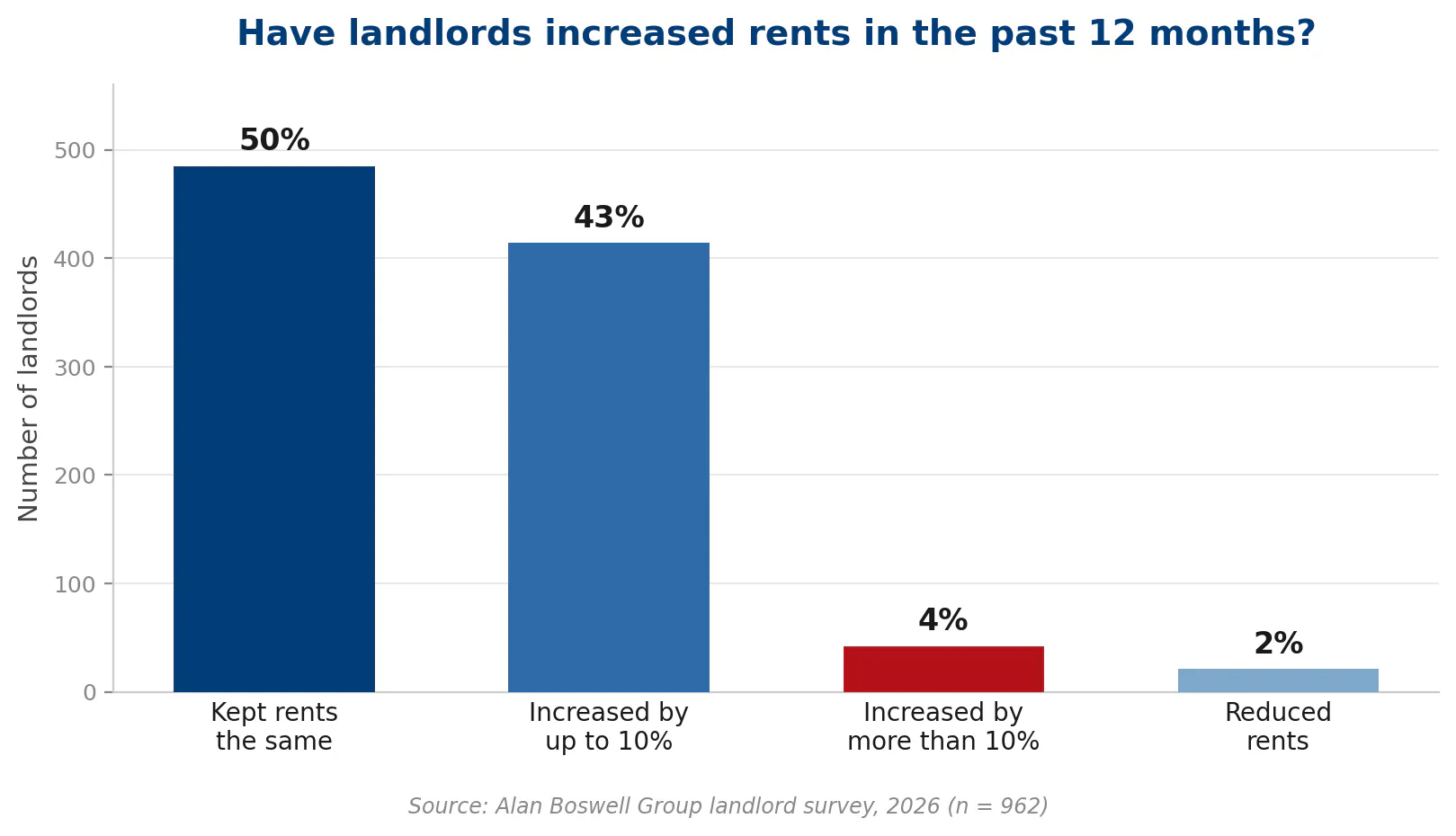
In practice, most landlords keep increases modest. In our recent survey of more than 950 landlords, those who did raise rent limited the increase to no more than 10%, with only around 4% increasing by more than that.
How to issue a Section 13 rent increase notice
As fixed-term tenancies no longer exist, the only way to initiate a rent increase is by issuing a Section 13 notice. This can only be done once every 12 months.
If you decide to increase your tenant’s rent, it’s a good idea to discuss it with them first, rather than simply giving them the official Section 13 notice. This can help you avoid unnecessary challenges.
To issue the notice and follow the Section 13 process, you’ll need to:
Download and complete form 4A from GOV.UK, where you’ll also find guidance about how to fill it in.
Check that you’ve given tenants at least two months’ notice.
Give tenants the form in person, by post, or by email (if this is an option in your tenancy agreement).
What happens if a tenant refuses a rent increase?
Your tenants can challenge the rent increase if they believe it’s above market rate or if the Section 13 notice was filled in incorrectly.
If your tenants think the increase is too high, they can appeal to the First-tier tribunal and ask them to review and set a revised rent. The tribunal will look at other properties in the area and compare your proposed increase to decide whether or not it’s reasonable.
Tribunals can’t set rent increases above your proposal, but they can either accept it or set a lower rent. Once the tribunal has decided on a fair increase, tenants will be expected to pay this new rent amount going forward.
You cannot evict tenants simply because they don’t agree to an increase.
Should you increase rent every year?
You don’t have to increase rent every year, but tenants may find small incremental increases easier to manage than a single large increase every few years. Nevertheless, even relatively small increases can force otherwise good tenants to leave if they can’t afford them or don’t feel they’re fair.
In our survey, half of landlords had not increased rents at all in the past 12 months, suggesting that many already weigh up increases against the risk of losing reliable tenants.
Fundamentally, it’s up to you as the landlord to weigh up whether an increase is worth the possibility of losing reliable long-term tenants, which is why discussing rent rises first can be helpful.
Bear in mind that if tenants receive Universal Credit and their rent exceeds the Local Housing Allowance (LHA) rate, they may fall into arrears.
Protecting your income if a rent increase leads to arrears
Monthly rent has increased steadily over the last few years, and with rising living costs, many households are being pushed to their financial limits; for some tenants, rental increases can be the tipping point.
As a landlord, the risk of tenants falling into arrears is a stark reality, and with the Renters’ Rights Act in place, the only route to eviction is through the Section 8 process. In practice, this means tenants must be in at least three months’ arrears before you can issue an eviction notice. Nevertheless, you can protect your income with legal & rent guarantee insurance, which covers lost rent if a tenant defaults (after two full months’ missed rent) and assists with the legal process to regain possession of your property. Just remember to consider your policy conditions. For example, if you raise rent by more than 10%, you may be required to re-reference your tenants to keep the policy valid. Not following any conditions means insurers can reject your claim.
FAQs
No. Landlords must give at least two months’ written notice of a rent increase and use the Section 13 process. Rent increases that do not follow this procedure are invalid.
There is no cap for rent rises within the private rental market in England. But within the social housing sector, increases are limited to in line with the CPI +1%, which could serve as a guide. As a rule of thumb, a fair rent would be one consistent with local market rates. If you have landlord insurance with rent guarantee cover, high rent increases (10% or more) may require you to re-reference tenants for affordability.
Landlords cannot increase rent in the first year of a tenancy. After that, landlords can only increase rent once every 12 months, and they must give tenants two months’ notice using the Section 13 process.
Yes. If you want to ask for a rent increase, you must issue a Section 13 notice each time.
Protect your assets with award-winning landlord insurance
Landlord responsibilities are vast and varied, but that shouldn’t be at the expense of protecting your assets. At Alan Boswell Group, we tailor policies to suit your needs, whether you’re an accidental landlord or are managing a portfolio of properties.
For more information about the essential cover we offer, including landlord building insurance, contents cover, legal & rent guarantee insurance and landlord legal expenses, speak to us on 01603 216399.
Need help with your insurance?
If you have a question regarding the insurance for your rental property or need a quote, we’re happy to help.
Related guides and insights

Guide to the Renters' Rights Bill
We look at the measures announced in the Renters' Rights Bill, and its impact on property insurance.

A guide to the different types of tenancy agreements in the UK
The Renters’ Rights Act has changed the way private renting works. We focus on what that means in practice for the different types of tenancy agreements in use and how it might affect your landlord insurance.

The ultimate list of landlord responsibilities
Whether you’re an experienced landlord or managing your first property, it’s important to understand your legal responsibilities, or you could end up facing hefty fines and even prosecution. We look at what those responsibilities are to help ensure you stay on top of your legal duties.
How to evict a tenant: a guide to the new rules
Section 21 ‘no-fault’ evictions no longer exist, which means you cannot evict a tenant because their tenancy term has ended, and the only eviction method is to issue a Section 8 notice. We explain the new rules and what that means in practice for landlords.